
HARDWARE, SILICON & AI ACCELERATION
Nvidia: The Technological Heart of AI Hardware
From gaming graphics cards and the CUDA ecosystem to Blackwell GB200 Superchip superchips: how Jensen Huang’s company engineered the indispensable infrastructure of global artificial intelligence.
Why Does the AI World Depend Absolutely on Nvidia?
Nvidia’s dominance is no accident: in 2006, Jensen Huang made a bold bet to equip every GPU with general-purpose computing capabilities (GPGPU) via CUDA, forging an unbeatable competitive moat across two decades.
While traditional CPUs execute a few complex instruction streams serially, GPUs from Nvidia integrate thousands of specialized Tensor Cores engineered specifically for massive parallel matrix multiplication—the fundamental operation of deep learning.
Today, Nvidia supplies far more than standalone chips: it delivers full datacenter supercomputing architectures (DGX SuperPOD), ultra-low-latency InfiniBand quantum switches, and an optimized software stack commanding over 85% of global AI training infrastructure.
Pillars of Nvidia’s Technological Empire
The foundational hardware and software platforms anchoring the generative AI revolution.
Dimensions of the Nvidia Technology Platform
An integrated end-to-end stack spanning microelectronics to cloud microservices.
🧮
Tensor Cores & FP4 Precision
Specialized mathematical compute units executing matrix multiplications with native low-precision quantization without sacrificing model fidelity.
⚡
NVLink 5 High-Bandwidth Interconnect
High-bandwidth communication fabric enabling up to 72 Blackwell GPUs to function as a unified, massive single-memory accelerator.
🌐
Omniverse & Industrial Digital Twins
Physically accurate, photorealistic simulation of manufacturing facilities, robotics, and smart cities prior to physical deployment.
🚗
Nvidia DRIVE (Autonomous Mobility)
Embedded automotive computing processing LiDAR, radar, and camera feeds in real time with mission-critical functional redundancy.
🤖
Project GR00T & Humanoid Robotics
General-purpose foundation model platform for bipedal and humanoid robots learning physical dexterity via accelerated GPU simulation.
📦
NVIDIA NIM Inference Microservices
Pre-optimized containerized microservices packaging frontier LLMs and vision models for instant deployment across any enterprise private cloud.
In Focus: Gaming Heritage, Datacenter Compute, and Geopolitics
How PC Gamers Funded the Modern AI Revolution
For more than two decades, consumer video game enthusiasts drove relentless demand for faster graphics cards capable of 3D polygonal rasterization and real-time Ray Tracing.
That massive consumer volume generated the essential cash flow for Jensen Huang to invest billions into the CUDA software architecture long before LLMs entered the public consciousness.
Read Full History →

The Silicon War: Semiconductor Sanctions on China
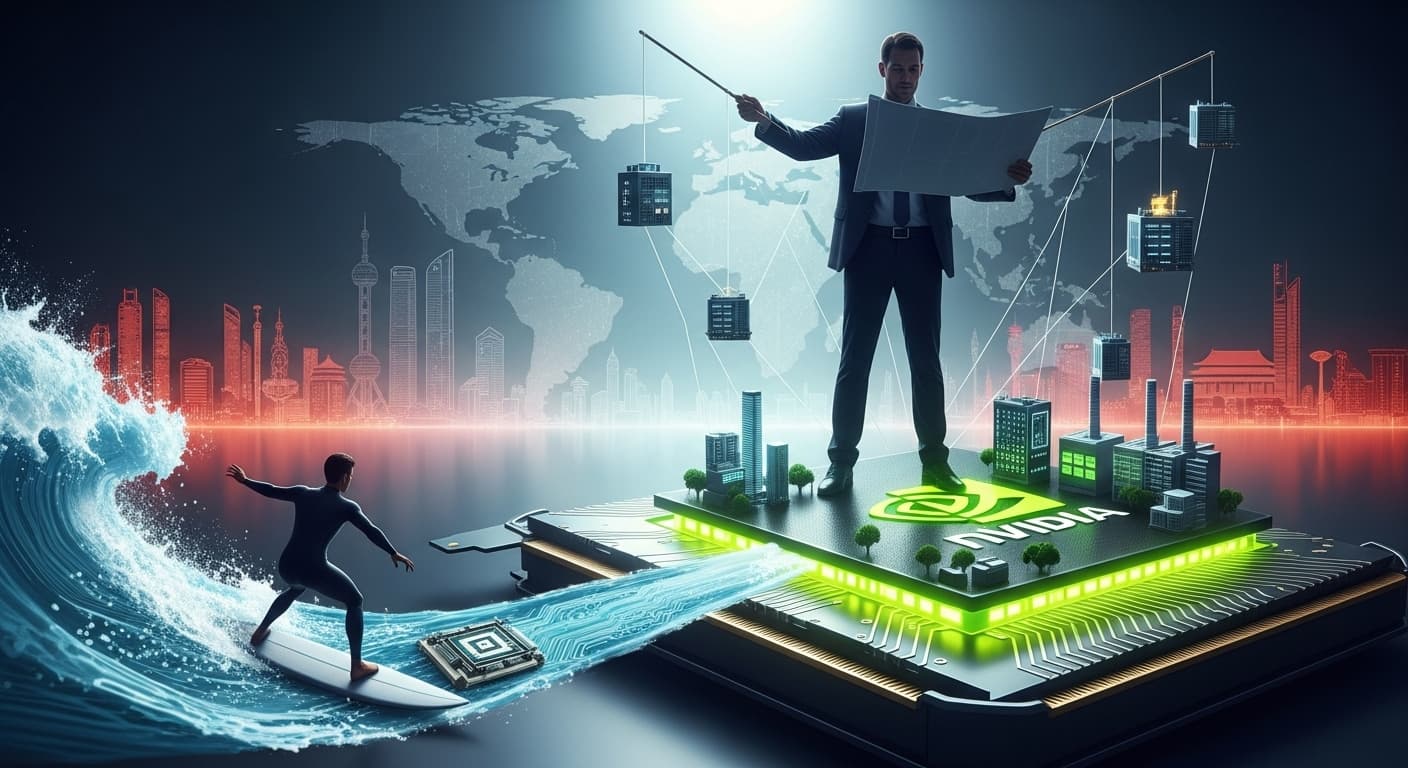
Control over leading-edge semiconductor lithography has become the focal point of US-China geopolitical competition. Export bans on frontier chips (A100, H100) prompted custom variants like the H20.
Concurrently, domestic Chinese technology giants like Huawei are rapidly scaling Ascend accelerators to secure national hardware sovereignty.
Explore Semiconductor Geopolitics →Architectural Evolution: Hopper vs. Blackwell
Direct comparison between the architectures defining global AI datacenter compute.
Hopper H100 / H200
The industry standard that trained GPT-4, LLaMA 3, and Gemini, featuring ultra-fast HBM3e memory and dedicated Transformer Engine acceleration.
- 80GB to 141GB ultra-fast HBM3e memory
- 700W TDP per SXM5 compute board
- Widespread enterprise deployment across AWS, Azure, and Google Cloud
Blackwell GB200 Superchip
Groundbreaking superchip fusing two B200 GPUs with a Grace CPU via ultra-fast 10 TB/s chiplet interconnect, engineered for trillion-parameter foundation models.
- Up to 30x higher LLM inference throughput
- Mandatory liquid cooling across NVL72 rack-scale systems
- Native FP4 precision quantization and inference
AMD Instinct MI300X & Custom TPUs
Challengers addressing market supply constraints: AMD accelerators with the open ROCm stack, alongside hyperscaler custom ASICs (Google TPU, AWS Trainium).
- 192GB unified memory on AMD Instinct MI300X
- Cost-optimized TPU v5e/v6 instances on Google Cloud
- Shorter procurement lead times and diversified multi-vendor supply chains
Future Bottlenecks: Power, Supply Chains, and In-House Silicon
Critical dynamics shaping semiconductor industry equilibrium over the next decade.
⚡ Power Density and Datacenter Cooling
A single GB200 NVL72 rack draws up to 120 kW. Grid power availability and closed-loop liquid cooling represent the single largest bottleneck for modern hyperscale datacenters.
🏭 TSMC Foundry Dependency & Advanced CoWoS Packaging
Nvidia operates as a fabless designer: manufacturing relies virtually 100% on TSMC advanced packaging (CoWoS) in Taiwan, concentrating substantial geographic supply chain risk.
⚙️ Big Tech’s Race for Custom In-House Silicon
Meta (MTIA), Microsoft (Maia), and Amazon (Inferentia/Trainium) are designing custom ASICs to mitigate multi-billion-dollar reliance on Nvidia’s 75%+ gross margins.
Related Articles and Technical Guides
Explore our deep-dive analysis on Nvidia’s compute ecosystem and hardware roadmap.
Need to Size and Architect AI Infrastructure for Your Enterprise?
At ComunicaGenia, we advise organizations on GPU compute cluster sizing, hybrid on-premise architectures, and inference cost optimization.
This post is also available in: